Release Readiness Gate
Hold a release until every service it touches meets its scorecard, with the reasons stated and a fix plan one click away.
These images are illustrations of the concept, not screenshots of the actual product.
Overview
Release Readiness Gate is a VibeControls concept for deciding, service by service, whether a release is ready to promote. It is designed to evaluate every service included in a PlanMagnet release against the team's scorecard thresholds, and to hold the whole release when any one of them falls short. The reason is stated in plain terms, so nobody has to decode a red light.
In a software company where coding agents now write a growing share of changes, the pace of change outruns the checklist. A release can bundle half a dozen services from different teams. The questions on-call depends on, such as whether a runbook exists, whether an error-rate alert is configured and whether each agent-authored change arrived with an approved plan, are often answered from memory in a meeting just before promotion.
The illustration shows a sample release opened inside a vibe, with a chip naming the linked PlanMagnet release and a status chip reading hold with two blockers. Four tiles count the services in the release, those passing the gate, those blocked, and the AI-authored changes alongside how many arrived with an approved plan. The main table lists each service with its owner team, a gold, silver or bronze tier, a numeric score, runbook and alert status, approved agent plans against changes made, and a pass or blocked result. For the selected blocked service, a side panel explains why it misses the gate: in the sample, a missing runbook link, an unconfigured error-rate alert and test coverage under its threshold, next to two checks that pass, a golden-path scaffold and an owner on the on-call rotation.
Below those reasons, a lead can open a fix plan or assign the work to the owner. The header adds Re-evaluate and Request exception, and the design envisions exceptions as time-boxed rather than open-ended. The gate builds on other VibeControls concepts: tiers and scores from the software catalog and quality scorecards, golden-path templates, and human-approved plans for agent work.
A footnote records that the gate result is posted to the PlanMagnet readiness checklist, with the time it was evaluated. The design intent is that PlanMagnet, where product and engineering plan the release, receives the same pass or hold the engineering view shows, so a release is never marked ready in one place while it is blocked in another.
What this concept shows
- A release header naming the linked PlanMagnet release, with a hold status and its blocker count
- Summary tiles for services in the release, passing, blocked, and AI-authored changes with approved plans
- A service table with owner, tier, score, runbook, alerts, agent plan approvals and a pass or blocked gate
- Runbook status shown as current, stale with its age, or missing
- A plain-language panel explaining why a selected service is blocked, listing failing, warning and passing checks
- Open fix plan and Assign to owner actions placed below the blocking reasons
- Re-evaluate and Request exception controls for the whole release
- A gate result designed to post back to the PlanMagnet readiness checklist with its evaluation time
How it works
- Open the release gate inside its vibe and check the pass or hold status for the linked PlanMagnet release.
- Read the summary tiles to see how many services pass, how many are blocked and how many AI-authored changes carry approved plans.
- Scan the service table for missing or stale runbooks, unconfigured alerts, low scores and agent changes without an approved plan.
- Select a blocked service to read the plain-language reasons it misses the gate.
- Open a fix plan or assign the work to the service owner, or request an exception for the release where it is justified.
- Re-evaluate the release once fixes land, so the new result posts back to the PlanMagnet readiness checklist.
Who it's for
- Platform engineering leads
- Engineering managers
- Release captains and release managers
- Service owners and on-call engineers
- Product managers tracking release readiness
Illustrations
1 illustration of this concept. Select one to view it full size.
Release Gate with Blocking Reasons
This illustration shows a release gate, with a breadcrumb leading from Vibes through a release-readiness vibe. The header names a sample release and carries a chip for the linked PlanMagnet release and a red chip reading hold with two blockers, with Re-evaluate and Request exception buttons to the right. Four tiles count services in the release, those passing the gate, those blocked and the AI-authored changes with how many plans were approved. The table lists six sample services with columns for owner, tier, score, runbook, alerts, agent plans and gate. Two rows are blocked: one with a missing runbook and an unconfigured alert, the other with a runbook marked stale and three of four agent plans approved. A side panel explains why the selected worker service is blocked, with failing, warning and passing checks, and offers Open fix plan and Assign to owner. A footnote says the result was posted to the PlanMagnet readiness checklist and gives the evaluation time.
Topics
- release readiness gate
- production readiness review
- release go/no-go checklist
- service scorecard thresholds
- release promotion gate
- AI-authored code governance
- coding agent change approval
- runbook and alert coverage
- engineering release management
- SaaS release process
Related concepts
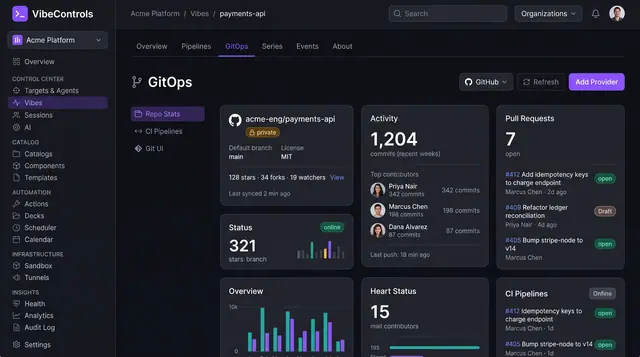
GitOps, Living Docs and Quality Scorecards
See a project's repository activity, its compiled documentation and a weighted quality score side by side, inside the vibe itself.
3 illustrations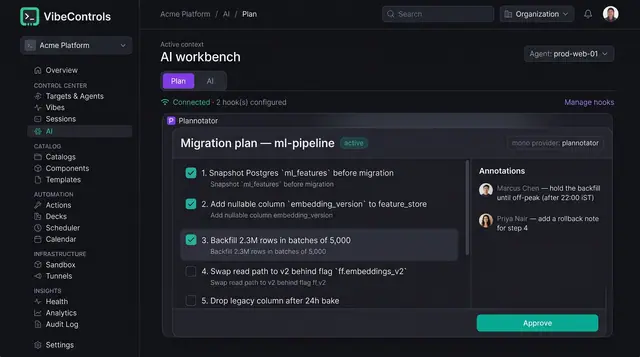
Human-Approved AI Plans
Agent work arrives as a numbered plan a person reads, annotates and approves before a single command runs.
2 illustrations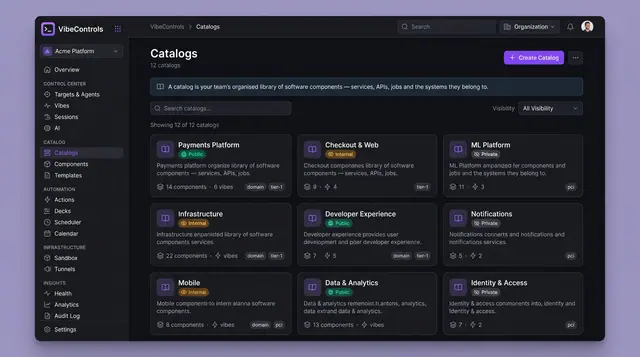
Living Software Catalog and Version Drift
A catalog that stays honest — systems, components, owners and dependencies, with per-environment version drift on one grid.
4 illustrations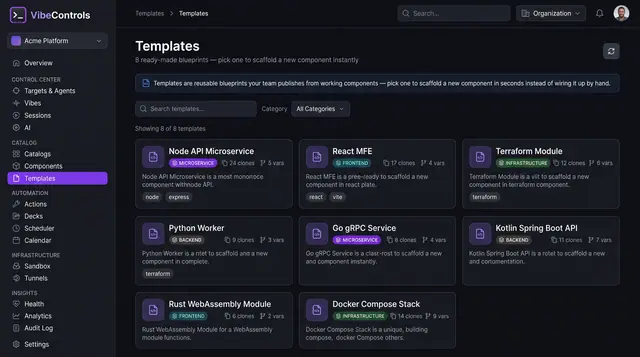
Golden-Path Templates and Scaffolding
Pick a team-approved blueprint, fill in a few variables and get a new component with its build, CI, ops deck and docs already wired.
2 illustrations
Part of an industry solution
This concept appears in a cross-product solution on burdenoff.com — see how it works alongside other Burdenoff products to solve a problem in that industry.