
Human-Approved AI Plans
Coding agents propose numbered plans that people review, annotate and approve before a single step runs.
These images are illustrations of the concept, not screenshots of the actual product.
Overview
Plan mode puts a deliberation step between what an AI agent intends to do and what it actually does. Instead of dispatching work immediately, the agent produces a structured, numbered plan that a person reads, comments on and approves. This concept illustrates two places where that checkpoint appears: plan review inside the AI workbench for coding work, and a queue of operational proposals for the wider fleet.
Coding agents with shell access can make high-impact changes such as database migrations, mass refactors, credential pushes and service restarts. Letting them act the moment they decide trades safety for speed, while blocking them entirely throws away the time they save. The design puts a human checkpoint exactly where the risk sits, and keeps the plan, the comments on it and the approval together so the reasoning behind a change is not lost in a chat log.
In the first illustration, the AI workbench switches from AI to Plan. An agent selector picks the machine the work targets, a status line confirms the connection and the configured hooks, and an embedded plan review panel shows a sample migration broken into numbered steps, each with a checkbox and a short summary. Reviewers leave annotations beside the steps, for example asking to hold a backfill until off-peak hours or to add a rollback note, and a single Approve button releases the plan. The second illustration applies the same idea to operations: a Proposals awaiting review list collects suggested fixes such as recovering a degraded agent or reconciling drifted catalog entries, and the selected proposal shows its steps, a reviewer note, an estimated credit cost and Approve plan and Deny buttons, with a reminder that nothing runs until the plan is approved.
Plans sit alongside the rest of the AI workbench. The Plan autonomy level on each agent keeps sessions read-only until a plan exists, estimated credits connect plans to AI metering, and approvals are designed to land in the same audit trail as every other operation in the fleet.
What this concept shows
- A Plan and AI toggle at the top of the AI workbench, with an agent selector for the machine the plan targets
- A connection status line showing how many hooks are configured, with a Manage hooks link
- An embedded plan review panel with numbered steps, each carrying a checkbox and a one-line summary
- An Annotations column where reviewers attach notes to specific steps
- A single Approve action that releases a reviewed plan for execution
- A Proposals awaiting review queue with tags such as agent health, resource reclaim, catalog drift and findings
- A proposal detail with ordered steps, a reviewer note, estimated credits and model, and Approve plan and Deny buttons
How it works
- Open the AI workbench, choose the target agent and switch from AI to Plan.
- Ask the agent for a change and let it draft a plan, which appears as numbered steps in the review panel.
- Work through the steps, ticking each one once reviewed and adding annotations such as timing constraints or rollback notes.
- Approve the plan to release it for execution on the selected agent.
- For fleet operations, open the proposals queue in AI tools and select a proposal awaiting approval.
- Read its steps, reviewer note and estimated credit cost, then approve or deny it.
Who it's for
- Platform and DevOps engineers running agents on shared or production machines
- Engineering leads responsible for change approval
- Developers who delegate migrations and refactors to coding agents
- SRE and on-call engineers handling fleet incidents
Illustrations
2 illustrations of this concept. Select one to view it full size.
Plan Review in the AI Workbench
This illustration shows the AI workbench in its Plan view. Breadcrumbs lead from the workspace through AI to Plan, a toggle switches between Plan and AI, and an agent selector at the top right chooses the machine the work targets. A status line reports that the workbench is connected and how many hooks are configured, with a Manage hooks link beside it. Below, an embedded plan review panel from a plan provider presents a sample migration plan for a machine-learning pipeline, marked active. Five numbered steps run from snapshotting a database table, adding a nullable column and backfilling rows in batches, through switching the read path behind a feature flag, to dropping a legacy column after a bake period. The first three steps are ticked. An Annotations column holds reviewer comments tied to specific steps, and an Approve button sits at the foot of the panel.
Proposals Awaiting Review
This illustration extends plan review from coding work to fleet operations. The AI tools page, with its Plan and AI switch, shows a Proposals awaiting review panel under a banner that labels the proposal engine as a concept. On the left, four proposal cards each state a problem and the evidence behind it: recovering a degraded agent that missed three heartbeats, reclaiming idle sandboxes past their time-to-live, reconciling catalog components that no longer match what agents report, and triaging new security findings that have no owner. Each card carries a category tag and an Awaiting approval badge. On the right, the selected proposal lists four ordered steps, from re-pushing gateway credentials to re-enabling a nightly session, followed by a reviewer note asking to confirm the maintenance window, an estimated credit cost with the model that would run it, and Approve plan and Deny buttons above a line stating that nothing runs until the plan is approved.
Topics
- AI plan approval
- human in the loop AI agents
- plan mode for coding agents
- approve AI changes before execution
- AI change review workflow
- agent proposal queue
- annotated AI plans
- governed AI automation
- database migration plan review
Related concepts
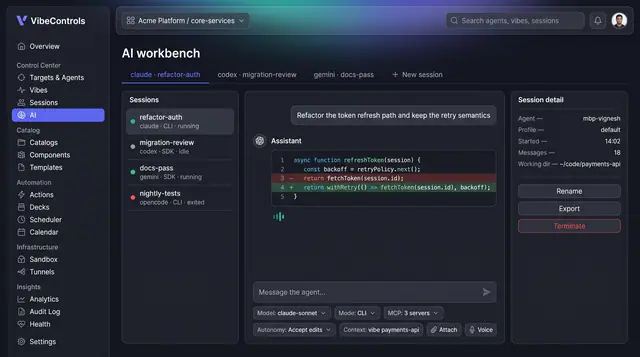
AI Workbench for Coding Agents
Run Claude Code, Codex, Gemini and other coding agents side by side, with governed actions, full run logs and saved answers.
4 illustrations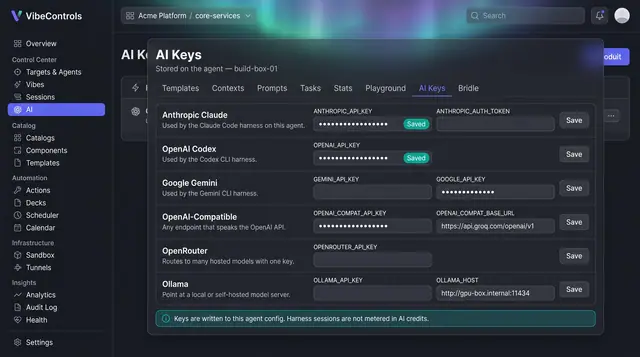
AI Provider Keys, Autonomy and Credits
Bring your own model keys, set how much each agent may do on its own, and see AI credit use before every message.
3 illustrations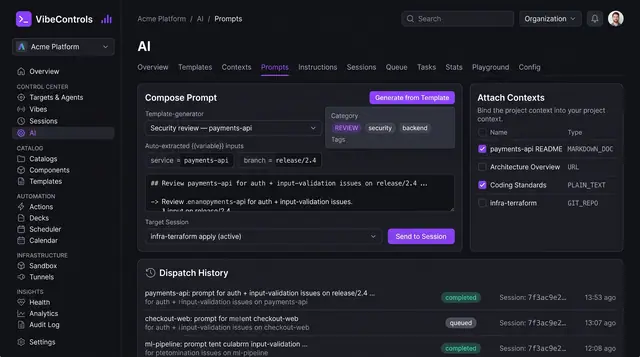
Reusable Prompts and Managed Contexts
Keep a library of parameterized prompts and curated context sources, then send them to any agent session in a click.
3 illustrations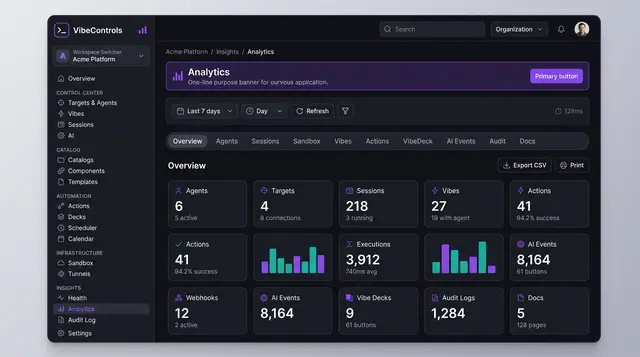
Usage Analytics and Audit Trail
Count what the fleet did over any period, then drill into a searchable record of who did what, where and with what result.
2 illustrations